
I frequently get emails asking me something like:
“Is anxiety genetic?”
And just as often, people ask:
- “Is depression genetic?”
- “Is panic genetic?”
- “Is procrastination genetic?”
In other words, the real question is:
“Is my problem genetic?”
Since this is the most misunderstood scientific topic I know of (in both popular culture and professional circles), I’ve done my best to simplify a very complex area.
Behavioural Genetics is the scientific field that studies how much genes influence psychological traits (patterns of feeling, thinking, and behaving).
It’s a highly complex field, but here are seven facts to know:
7 Facts About Genes and the Mind
1. Life needs genes. Without genes, you wouldn’t exist.
2. Genes aren’t destiny. No single “anxiety,” “depression,” or “trauma” gene has ever been found.
3. Media headlines mislead. Hype about “the gene for depression” or “the gene for shyness” rarely survives replication and better methods.
4. Tiny effects, not big causes. Hundreds or thousands of genes each play minuscule roles, always interacting with the environment.
5. Pleiotropy: one gene, many effects. The same genetic variation can influence differences in multiple traits, and in some contexts may contribute to strengths or resilience as well.
6. Even the most heritable traits can change. Height and IQ have shifted dramatically in a few generations due to changes in nutrition, education, and culture.
7. Your brain evolved for flexibility. It has an immense ability to learn new patterns and let go of old ones.
Bottom line: Genes are not a prison. They’re one variable among many that influence tendencies and probabilities, not certainties.
To sum up, genes don’t doom anyone to anxiety or to any other psychological struggle.1
Genes clearly influence how we grow and develop.
We are not born as blank slates.
But genes give us tendencies, not a fixed future.
It is also important to know that whenever scientists talk about the role of genetics in psychological suffering, they are referring to population statistics (meaning group averages). Heritability estimates cannot tell us anything about one specific person and they cannot predict your personal future.
Our brains evolved to be flexible and able to quickly adapt. This is why, when we take the right approach, you can quickly and automatically learn more useful ways of thinking, feeling and behaving.
I’ve had countless clients who once believed they were trapped by their DNA, only to discover they weren’t.
And, over the years, I’ve also heard from countless Panic Free members who, after becoming panic-free, introduced one or more family members to the program, who then also became panic-free. Panic stopped ‘running in the family’.
You’re not doomed to a life of emotional suffering by your genes.
Change is possible, and often much faster than you imagined.
Deeper Into The Science
1) Correlation Isn’t Causation
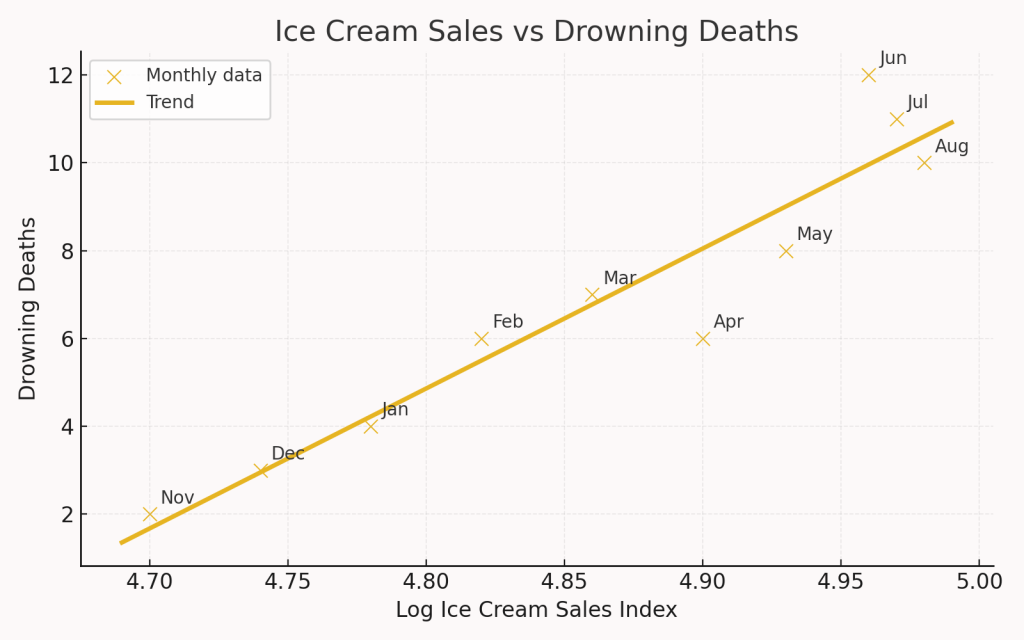
Ice-cream consumption and drowning rates rise in summer and fall in winter. They go up and down together, but ice-cream doesn’t cause drowning. A third factor, the hot weather, drives both. That’s a correlation, not a cause.
Why this matters for genes & psychology
Most evidence in behavioural genetics (twin studies, SNP heritability, polygenic risk scores) is correlational.
These studies might tell us that two things statistically go together, but on their own they don’t prove that one causes the other.
Watch the language trick
As the influential behavioural geneticist Eric Turkheimer puts it: social scientists often make correlations sound like causes, giving them “an air of scientific magic they don’t really deserve.”
They might use a phrase like,
- “X is linked with Y.”
- “X is associated with Y.”
- “X explains Y.”
- “X predicts Y.”
- “X is a risk factor for Y.”
- “X is connected to Y.”
- “X contributes to Y.”
- “X underpins Y.”
- “X accounts for Y.”
These sound causal, but they’re really just saying that X and Y tend to rise and fall together in group data (like ice-cream sales and drowning in summer).
That’s correlation, not causation. And correlations don’t tell us anything definitive about you as an individual.
The media often go further and report these as causes.
- “Scientists discover the depression gene.”
- “Is anxiety in your DNA?”
- “Found: the gene that makes you shy.”
Headlines like these make it sound as if scientists have found a single, decisive cause. In reality, these findings are population-level correlations. No single gene has ever been shown to cause psychological patterns like anxiety or depression.
The take home message?
When you hear about supposed ‘genetic causes’ for mental or emotional suffering, remember this: they tell us nothing about your unique destiny. The link between genes and complex human behaviour is far messier, far more indirect, and far less deterministic than the simple cause-and-effect stories we’re usually told.
2) The “Missing Heritability” Problem
As our research tools have improved, it’s become clear that many mental and emotional patterns are far less correlated with measured genetic differences than once thought.
Twin and family studies often suggested moderate heritability, commonly in the rough range of 40–50% for many psychological traits.2
Modern DNA-based studies (SNP heritability, based on common variants) usually find much smaller numbers, closer to 10%.
And in the newest within-family designs that strip out indirect influences, Direct Genetic Effect (DGE) estimates are smaller still, sometimes in the low single-digit percentages.
That is a substantial correction: what once looked much larger now appears smaller and more indirect than earlier estimates suggested.3.
3) The Take-Home Message
When you hear about supposed “genetic causes” of mental or emotional suffering, remember:
- These are population-level correlations, not individual destinies.
- They describe group averages, not your unique story.
- And most importantly: patterns are learned, which means they can be unlearned.
What we inherit are tendencies, not traps. Genes are one variable among many that influence tendencies and probabilities, not certainties.
This is why the right psychological tools can change a life. It’s what I’ve devoted my work to—and why so many of my clients discover freedom much faster than they ever thought possible.
Still stuck with anxiety, panic, or fears that you can't think your way out of?
Free personalised help, based on 25+ years and 103+ countries.
- Receive my acclaimed Instant Calm deep-relaxation session, FREE. Listened to by over 4 million people, this unique '3D' experience effortlessly melts stress, quiets your mind, and calms your body.
- Plus, a free email series that shows you why your pattern keeps happening, what's actually maintaining it, and how to start changing it. Personalised to your situation after a short 10-20 second quiz.
- Discover the practical science of Automatic Change, and how the solution can become as effortless and automatic as the problem once was.
Even if you've tried everything and nothing has lasted.
Free for now.
Footnotes for the anyone who wants the intricate details:
- Very rarely, single-gene disorders (for example, certain metabolic or neurodevelopmental conditions) can produce syndromes that include anxiety-like symptoms. But this is not what most people mean when they ask whether anxiety is ‘genetic’. The focus here is on common psychological traits studied in behavioural genetics, where no single gene has been shown to deterministically cause patterns like anxiety or depression. ↩︎
- Those figures can be inflated because family designs rest on assumptions that don’t always hold—like identical twins sharing environments equally with fraternal twins. They can also pick up effects of assortative mating (people with similar traits pairing up), population stratification (genetic differences tied to ancestry rather than traits), and indirect genetic effects or “genetic nurture” (parents’ genes shaping the home environment, which in turn affects children). ↩︎
- The role of stochastic effects matters too (for example, chance events during development, especially in how neurons connect with each other). Even “identical twins,” who share the same DNA and grow up in the same home, are never truly identical. When it comes to mental and emotional patterns, outcomes are rarely fixed in advance—which is why no one can look at your DNA and predict your psychological future with certainty. ↩︎