
Neuroplasticity and Trauma Recovery: An 80 Year-Old Reverses Nine Years of Highway Panic in One Session
Mary* was an 80 year-old woman who caused a multi-car accident on a highway nine years ago.
It was a near-fatal accident that led her to completely avoid highways.
“Cars hitting my car from all directions”, Mary told me as we started talking.
“I panic merely thinking about highways now. What if I’m wired to be this way forever?”
I shared a quote from Professor Lisa Feldman Barrett, who has been called ‘the most important affective [emotion] scientist of our time’:
“When people talk about brain wiring it’s a metaphor [emphasis mine].
Neurons aren’t soldered together.
They’re separated by small gaps called synapses.
Connections are completed in the synapses by chemicals.
This arrangement lets your brain configure into different patterns of activity quickly.”
“But I’m 80 years-old,” said Mary.
“Does my brain still have neuroplasticity?”
Mary, having read Norman Doidge’s 2007 best-selling book ‘The Brain That Changes Itself,’ was referring to the scientific term used to describe what Feldman Barrett was talking about.
“Well, my oldest client this year, currently 92, is doing great. So, I’m sure we can give you indisputable proof—today, before we end this call—that your brain can make the changes you want,” I replied.
Over the next 75 minutes, I worked with Mary the way I work with every client—not from a script, a protocol, or a predefined sequence of steps, but from what she, specifically, needed. It’s a way of working I learnt from Milton Erickson, and a large part of why he achieved results that left the rest of the field struggling to explain him.
At the end of the call, I asked Mary:
“At the start of the session, you couldn’t even think of driving on a highway without feeling panicky. Go ahead and think of driving on the highway now—how do you feel now?”
“Nothing. Just relaxed,” Mary said.
“Try harder to get the panic back. Think about the accident you had and try to worry about something similar happening again.”
“Nothing. I still just feel relaxed.”
The final test was for Mary to go out and drive on a highway.
Three days after our 75-minute session she emailed me:
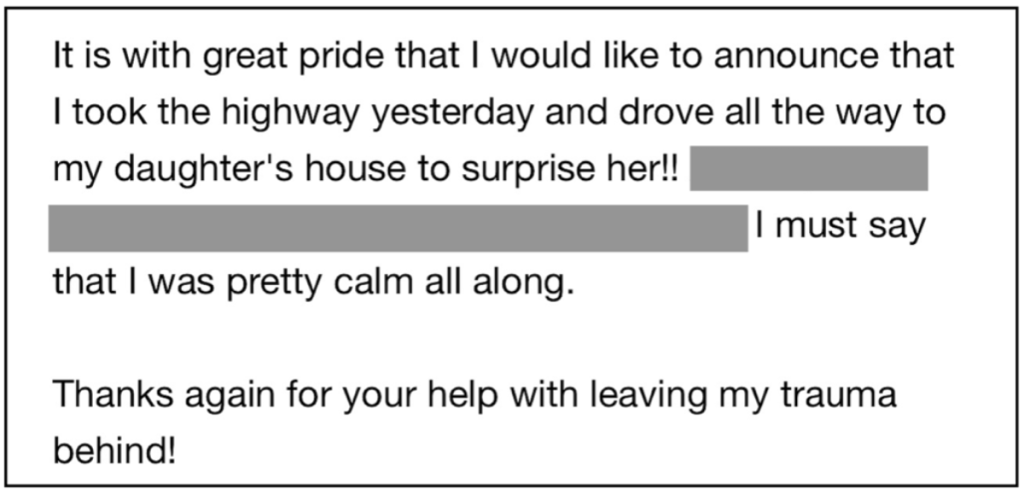
*Identifying details removed.
A year later, she wrote again:
“I can’t believe it’s already one year since we last talked. As you can see, I haven’t needed a second session.”
What’s the message in all of this?
Our brains evolved to be highly flexible.
The very mechanism that allowed Mary’s brain to learn fear on the highway is the same mechanism that allowed it to unlearn it.
Evolution is often taught as ‘survival of the fittest’, which is often erroneously taken to mean ‘survival of the strongest’.
A more useful phrase would be: ‘survival of the most adaptable.’1
Your brain evolved to be adaptable, so that you can meet the many challenges of life.
The same mechanisms involved in learning unwanted responses after traumatic experiences can learn calm.
It’s one of the prime reasons the human species continues to thrive.
But it comes with both an upside and a downside.
The downside: life events—traumatic or not—can lead us to learn unhelpful automatic responses. This is the greatest single cause of most limiting mental and emotional patterns.
The upside: if we utilise the very same mechanism (your brain’s amazing ability to learn) in a more useful way, we can transform those limiting responses—and often very quickly and easily.
Your brain’s ability to ‘configure into different patterns of activity quickly’, to use Feldman Barrett’s phrase, is a beautiful evolutionary gift.
It’s a gift that’s built into the architecture of your brain.
It’s a gift that allows us to change, grow, and let go of limiting beliefs, emotional responses and habits.
And, fortunately, it’s also a gift that, as far as I can tell, stays with us for as long as we live.
You have this gift, right now, inside you.
Enjoy Instant, Automatic Relief. Free.
- Receive my acclaimed Instant Calm deep-relaxation session—FREE. Listened to by over 4 million people, this unique ‘3D’ experience effortlessly melts stress, quiets your mind, and calms your body.
- Join the priority waiting list for my 1-on-1 help. You'll be first to know when openings become available.
- Receive occasional insights into the practical science and art of fast, lasting, and effortless Automatic Change.
For 25+ years, I’ve helped people in 103+ countries create fast, lasting, life defining, Automatic Changes—and I’d love to help you now.
Price: $0 (for now)
Footnotes for the Scientifically Curious
- ‘Survival of the fittest’ was coined by Herbert Spencer, and ‘fittest’ refers to reproductive fitness. Also, if an environment remains stable, organisms with little flexibility can be enormously successful evolutionarily. ‘Adaptability’ becomes the decisive advantage specifically when environments change, as they so often do for us humans (socially and in other ways). ↩︎