
If you’ve ever felt like therapy hasn’t given you the results you hoped for, you’re not alone.
Decades of research show that, on average, people who go to therapy do somewhat better than similar people who don’t.
But ‘somewhat better’ sets a pretty low bar.
As we’ll see, the real impact of therapy is often smaller than people are led to believe—and far from the life-changing transformation most hope for.
Even worse, many people spend months or even years in therapy, only to walk away with little to show for it besides a pile of receipts.
And when therapy doesn’t deliver, people often blame themselves. This leaves them feeling even more inadequate, ashamed, or ‘broken’ than before they sought help.
This lack of progress can leave people feeling hopeless, haunted by the fear that they’ll be stuck with their struggles forever.
So, if any of this resonates with you, here’s what I want you to know:
It’s not your fault.
You are not to blame.
And there is a better way.
Enjoy Instant, Automatic Relief. Free.
- Receive my acclaimed Instant Calm deep-relaxation session—FREE. Listened to by over 4 million people, this unique ‘3D’ experience effortlessly melts stress, quiets your mind, and calms your body.
- Join the priority waiting list for my 1-on-1 help. You'll be first to know when openings become available.
- Receive occasional insights into the practical science and art of fast, lasting, and effortless Automatic Change.
For 25+ years, I’ve helped people in 103+ countries create fast, lasting, life defining, Automatic Changes—and I’d love to help you now.
Price: $0 (for now)
Part 1: Uncomfortable Truths About Mainstream Therapy
Imagine stepping into the late 1960s.
Computers filled entire rooms.
Video calls were the stuff of science fiction.
And the idea of ‘carrying millions of songs in your pocket,’ as Steve Jobs famously put it—let alone having instant access to nearly every song, TV program, and movie ever released—was hard to imagine.
Technology has transformed nearly every aspect of our lives.
Shockingly, though, psychotherapy outcomes have stagnated for over fifty years.
This is in sharp contrast to the hard sciences, where progress is not just expected—it’s the norm.
Unfortunately, the scientific evidence paints an even grimmer picture:
- Licensed therapists, on average, perform no better than students or unlicensed practitioners—and sometimes worse.
- Advanced degrees like Ph.D.s don’t reliably make any difference to therapy outcomes.
- Neuroscience research has, so far, failed to make psychological change easier.
- The supposed “special ingredients” of mainstream therapies don’t account for better results. (For example, Cognitive Behavioural Therapy—CBT—achieves the same outcomes even when its defining ‘cognitive’ component is removed.)
‘What’s the difference between a trained therapist and a compassionate friend? Look at outcomes and you are likely to be disappointed [by the lack of difference].’
—Dr. Scott Miller.
This begs a critical question: Why?
Why has the field of mental health stagnated for over half a century, while the hard sciences have raced light-years ahead?
While there are multiple factors involved, I believe the biggest is a field stuck in an outdated and scientifically-impoverished paradigm of change.
Challenging this paradigm often invites scorn, dismissal, and the label of heretic.
But as Thomas Kuhn, the great philosopher of science, reminds us:
“When paradigms change, the world itself changes.”
—Thomas Kuhn
Part 2: The Scientific Evidence
1. Therapy Outcomes Have Not Improved In Over Five Decades.
‘[Psychotherapy] outcomes have remained flat for more than five decades.’
—Miller, S. D., Hubble, M. A., & Chow, D. (2018). The question of expertise in psychotherapy. Journal of Expertise, 1(3), 187–200.
Thanks to decades of research, we can now compare the earliest trials on therapy’s effectiveness with the latest studies.
Using a type of study called a meta-analysis—which analyses findings from many studies—researchers have shown that psychotherapy’s effectiveness has not improved over the last five decades.
Professors Bruce Wampold and Zac Imel, in their 2015 book The Great Psychotherapy Debate, framed this more diplomatically, noting that the efficacy of therapy has remained ‘remarkably consistent’ over the decades.
Dr. Scott Miller, another world expert, was more direct at the world’s premier psychotherapy conference, The Evolution of Psychotherapy:
‘There has been no improvement in treatment outcomes. None, zero, zip, nada. We’ve tried desperately to get better, but the outcomes are not getting better.’
And a major 2017 review by Professor Dragioti and her colleagues, examining thousands of recent psychotherapy studies, found that while therapy often helps, its benefits are frequently exaggerated.
Decades of research.
Thousands of studies.
And still—therapy, on average, is no more effective than it was 50 years ago.1
2. Neuroscience Research Has Not Improved Therapy Outcomes
For decades, billions of dollars have been poured into neuroscience research—yet it has failed to move the needle on psychological suffering.
Even the former head of the U.S. National Institute of Mental Health (NIMH), Thomas Insel, openly admitted:
“I spent 13 years at NIMH really pushing on the neuroscience and genetics of mental disorders, and when I look back, I realize that while I think I succeeded in getting lots of really cool papers published by cool scientists at fairly large costs—I think $20 billion—I don’t think we moved the needle.”
—Thomas Insel, Former Director of NIMH
While neuroscience has provided valuable insights into brain function and mental processes, and can help explain underlying mechanisms, it has not translated into better therapy outcomes.2
This highlights the limits of biological reductionism—the belief that mental suffering can be explained primarily through brain chemistry and genetics, and that solutions should be found at the biological level.
Professor David Kingdon echoed this in a 2020 paper:
“Unfortunately, it is still not possible to cite a single neuroscience or genetic finding that has been of use to the practicing psychiatrist in managing [mental health issues] despite attempts to suggest the contrary.”
—Kingdon, D. (2020). Why Hasn’t Neuroscience Delivered for Psychiatry?
(For a deeper dive into the widespread misunderstandings of genetic research on psychological suffering—by both media and professionals—see my post: The Myth of the “Anxiety Gene”.)
The eminent psychiatrist Allen Frances has been equally outspoken, criticising neuroscience’s failure to produce real-world benefits—both in scientific journals and public forums, as seen in this tweet:
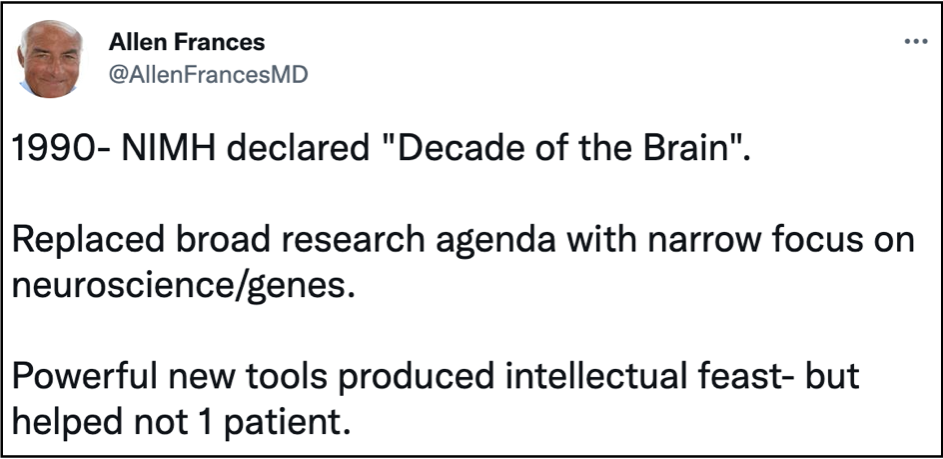
Why is neuroscience hyped as integral to psychological change, despite its failure to improve therapy outcomes?
Because neuroscience sells.
A famous Yale study by Deena Weisberg and her colleagues found that adding even irrelevant neuroscience terms creates a ‘seductive allure’ of credibility—making claims seem more scientific, even when they’re not.
While neuroscience may one day lead to breakthroughs in easing psychological suffering, decades of research and billions spent have yet to translate into real, meaningful benefits for those seeking psychological change.
3. Advanced Degrees Don’t Lead to Better Therapy Outcomes.
Understandably, most people assume that formal mental health training leads to better therapy outcomes—but the research tells a different story.
As Professors Christensen and Jacobson put it:
‘In most professions, it would be ludicrous to compare a trained and an untrained person. It is hard to imagine a study comparing trained and untrained surgeons, or trained and untrained electricians for that matter. Dead patients in the first instance or dead trainees in the second could be the unfortunate outcome. Not only should we expect significantly better outcomes for professionally trained therapists relative to nonprofessional therapists, but the [difference] should be substantial.’
Unfortunately the evidence strongly suggests that under many if not most conditions, [students and unlicensed helpers] or professionals with limited experience perform as well as or better than professionally trained psychotherapists. Professional training and clinical experience may not add to the efficacy of psychotherapy.’
—Christensen, A., & Jacobson, N. S. (1994). Psychological Science, 5(1), 8-14.
In their review, Christensen and Jacobson found that most studies showed no difference in client outcomes between licensed and unlicensed therapists.
Worse, in twelve separate studies, unlicensed therapists actually outperformed their licensed counterparts.
And this isn’t just an old finding—more recent research confirms the same trend.
A 2010 Penn State study found that neither years of training nor degree status were associated with better therapy outcomes.
Likewise, in a 2018 review, Dr. Scott Miller and colleagues summarized the evidence bluntly:
‘Study after study reveals degreed professionals perform no better than students.’
4. Cognitive Therapies: The ‘Gold Standard’ That Isn’t.
“‘Evidence-based therapy’ has become a marketing buzzword… Empirical research actually shows that ‘evidence-based’ therapies are ineffective for most patients most of the time… One could argue that ‘evidence based,’ as the term is now applied to psychotherapy, is a perversion of every founding principle of evidence-based medicine.”
—Jonathan Shedler, PhD, Psychiatric Clinics of North America, 41(2), 319–329.
Cognitive therapies—including CBT, ACT, DBT, MCT, and MBCT—are among the most widely practiced approaches to personal change.
They’re aggressively marketed as ‘evidence-based’ and the ‘gold standard’ of therapy.
But research tells a different story.
As Professors Bruce Wampold and Zac Imel explain in The Great Psychotherapy Debate:
‘Generally, cognitive therapies do not produce statistically different outcomes from other [common] therapies.’
A large study in the Netherlands further tested this by comparing CBT with a time-limited version of Freud’s psychodynamic therapy, which is based on methods developed well over a century ago.
The results?
‘CBT and short-term psychodynamic psychotherapy provide similar outcomes for patients… but remission rates at the end of treatment are low for both treatments.’
—Driessen, E., et al. The efficacy of cognitive-behavioral therapy and psychodynamic therapy in the outpatient treatment of major depression: A randomized clinical trial. American Journal of Psychiatry, 170(9), 1041–1050. (2013)
Even within CBT, one of its most celebrated features—the cognitive component (‘restructuring’ thoughts)—has been repeatedly shown to add little or nothing to outcomes.
Since Professor Neil Jacobson’s groundbreaking work in 1996, studies have continued to show that removing the cognitive component entirely makes no difference to outcomes.
And CBT isn’t the exception—it’s the rule.
Again and again, research finds that the so-called ‘special ingredients’ in mainstream psychological therapies don’t actually improve results.
For all the hype around CBT and cognitive therapies, they typically perform no better than some of the oldest methods.
5. On average, therapists don’t get better with experience
Most professions assume that experience leads to mastery. But in therapy, the evidence suggests otherwise.
A large-scale five-year study of 6,500 psychotherapists found:
‘Therapists tended on average to obtain slightly poorer outcomes as experience increased’
—Goldberg, S. B., Rousmaniere, T., Miller, S. D., Whipple, J., Nielsen, S. L., Hoyt, W. T., & Wampold, B. E. (2016). Do Psychotherapists Improve With Time and Experience? A Longitudinal Analysis of Outcomes in a Clinical Setting. Journal of Counseling Psychology, 63(1).
Unless they take the right steps to improve, many therapists stagnate—and on average, outcomes may even decline with time.
Yet, some therapists consistently achieve dramatically better results than others—despite using the exact same approach.
As renowned depression expert Michael Yapko has argued:
“We don’t need evidence-based treatments. We need evidence-based therapists.”
—Michael Yapko
And the evidence supports him.
The key difference isn’t the method—it’s the practitioner.
And the impact of the right practitioner is staggering.
At Brigham Young University, John Okiishi and colleagues analysed 1,841 clients across 91 therapists. They found that clients of the best therapists improved up to ten times faster than average, while clients of the least effective therapists actually deteriorated.
That was just from a study of 91 therapists.
Now, imagine what the best in the world can do.
The takeaway is clear:
The person you choose to help you make changes isn’t just a factor in determining results—it’s arguably the most important factor.
We Need a Better Way
‘A bad system will beat a good person every time.’
— W. Edwards Deming
Science moves forward.
It refines.
It evolves.
It improves.
Yet, for more than five decades, therapy outcomes haven’t.
If therapy were built on solid scientific ground, the picture would look very different.
We wouldn’t still be asking:
- Why haven’t therapy outcomes improved in over 50 years?
- Why do licensed therapists perform no better than students—and sometimes worse?
- Why don’t advanced degrees or neuroscience breakthroughs lead to better results?
- Why do the so-called ‘evidence-based’ ingredients of mainstream therapies—like Cognitive Behavioural Therapy—fail to work as advertised?
These aren’t minor issues.
They reveal a field stuck in groupthink—in an outdated, scientifically impoverished model of change, despite decades of effort.
Thankfully, history shows us that outdated models don’t last forever.
For me, understanding this science—much of which was clear even 25+ years ago—made the choice seem simple.
I followed the evidence because that’s what the scientific method is about.
I didn’t expect the resistance I’d face at times—but thankfully, clients care about one thing:
Results.
And throughout it all, the words of Nobel laureate Bertrand Russell stayed with me:
‘The fact that an opinion has been widely held is no evidence whatever that it is not utterly absurd.’
— Bertrand Russell
Enjoy Instant, Automatic Relief. Free.
- Receive my acclaimed Instant Calm deep-relaxation session—FREE. Listened to by over 4 million people, this unique ‘3D’ experience effortlessly melts stress, quiets your mind, and calms your body.
- Join the priority waiting list for my 1-on-1 help. You'll be first to know when openings become available.
- Receive occasional insights into the practical science and art of fast, lasting, and effortless Automatic Change.
For 25+ years, I’ve helped people in 103+ countries create fast, lasting, life defining, Automatic Changes—and I’d love to help you now.
Price: $0 (for now)
- Despite claims of breakthroughs, modern PTSD treatments are built on exposure methods that have been around for over 50 years. I avoid exposure for PTSD, as it’s slow, cumbersome, and up to half of clients drop out because they find it too distressing. In my practice I often see in a single session the kinds of changes exposure may take weeks or months to produce—if it produces them at all. The one exception is interoceptive exposure for panic, which can be powerful when used with precision to create targeted prediction errors rather than the traditional focus on pure habituation. ↩︎
- It’s sometimes assumed that advances in neuroscience have directly led to breakthroughs in widely used treatments. In practice, it is difficult to identify treatments that were derived from neuroscience-driven first principles rather than emerging through a mix of empirical discovery, trial and error, and later theoretical explanation. This is a point acknowledged by several prominent researchers in the field. Deep brain stimulation is an exception to this. It is a potentially important medical intervention that has helped some people, but it has not translated into improvements in routine psychotherapy outcomes. ↩︎